R: 4.3.2 (2023-10-31) R studio: 2023.12.1+402 (2023.12.1+402)
一、Market Basket Analysis
市场购物篮分析
| |
• 市场购物篮分析,又称亲和性分析,根据它们在数据集中的共同出现,揭示不同实体之间的有意义的相关性。 • 它生成满足预定义标准的关联规则,以识别频繁项目集中最重要的关系,并帮助揭示大数据中的隐藏模式。
Benefits of Market Basket Analysis
• When you understand product relationships and purchase sequences, you can identify and track customers who have bought a given product and deliver tailored messages to them. • With personalization, you’re also able to create more effective marketing campaigns.
| |
• Market basket analysis might tell a retailer that customers often purchase shampoo and conditioner together, so putting both items on promotion at the same time would not create a significant increase in revenue, while a promotion involving just one of the items would likely drive sales of the other.
| |
• Inventory management
| |
• Refine marketing
| |
二、Key terms
一个项目集是由形成关联规则的所有项目的列表表示。
一个关联规则,{面包,鸡蛋} => {牛奶},或更普遍的 {X} => {Y},表明如果顾客一起购买面包和鸡蛋,他们很可能也会购买牛奶。
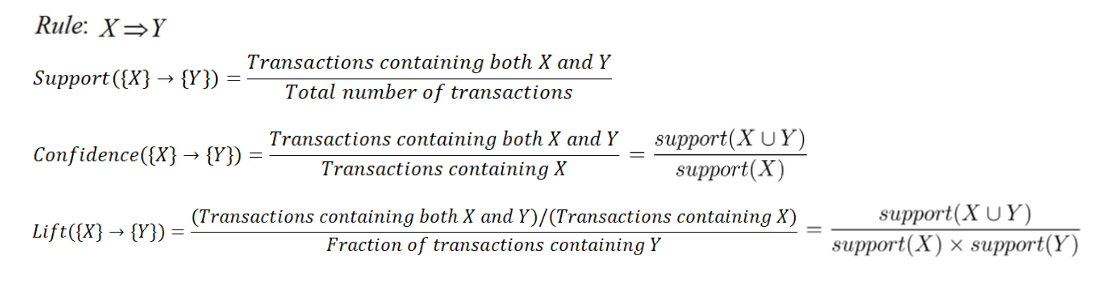
• Support is a measure of absolute frequency.
| |
• Confidence is a measure of correlative frequency.
| |
• Lift is a measure of the strength of association between the products on the left and right hand side of the rule.
| |
• Association Rule: {X → Y} is a representation of finding Y on the basket which has X on it
• Itemset: {X,Y} is a representation of the list of all items which form the association rule
• Support: Fraction of transactions containing the itemset
• Confidence: Probability of occurrence of {Y} given {X} is present
• Lift: Ratio of confidence to baseline probability of occurrence of {Y}
| |