1
2
3
4
5
6
7
8
9
10
11
12
13
14
15
16
17
18
19
20
21
| 1. Procedures. A procedure is a piece of Mesa text containing algorithms, local data, parameters, and results. It always operates in the scope of a Mesa module and may access any global data declared in that module (as well as in any containing procedures).
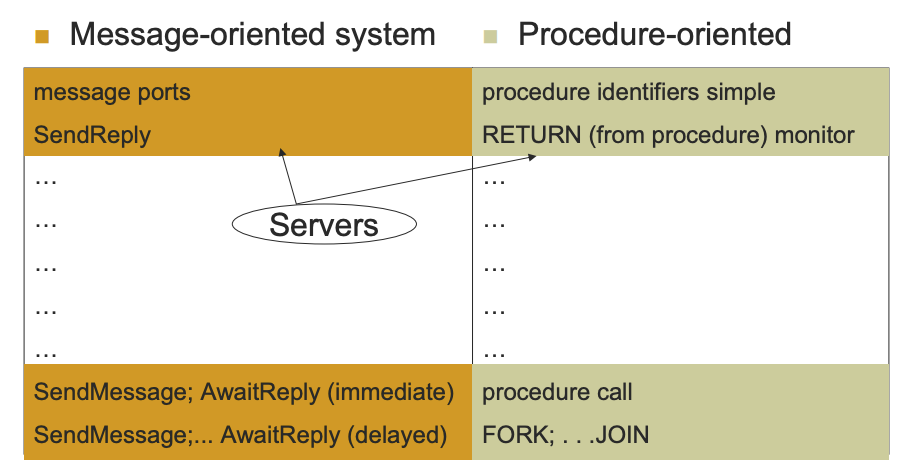
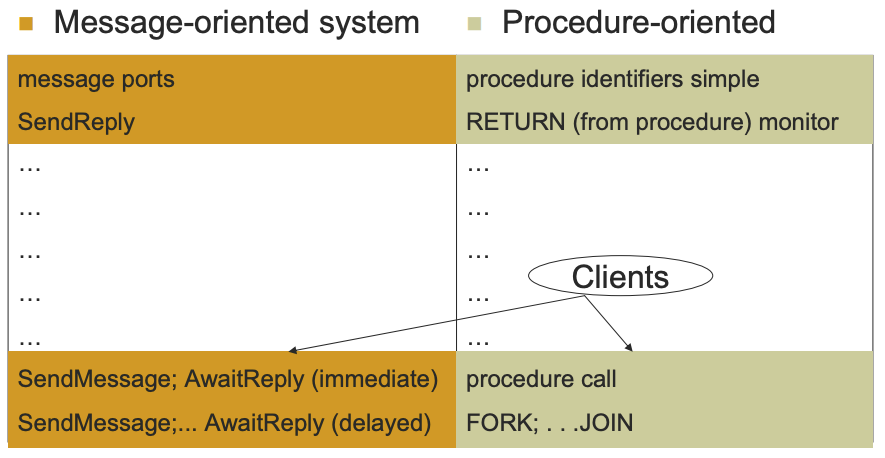
2. Procedure call facilities, synchronous and asynchronous. The synchronous procedure call mechanism is just the ordinary Mesa procedure call statement, which may return results. This is very much like procedure or function calls in Algol, Pascal, etc. The asynchronous procedure call mechanism is represented by the FORK and JOIN statements, which are defmed as follows:
1) processld <- FORK procedureName[parameterList] - This statement starts the procedure executing as a new process with its own parameters. The procedure operates in the context of its declaration, just as if it had been called synchronously, but the process has its own call stack and state. The calling process continues executing from the statement following the FORK. The process identifier returned from FORK is used in the next statement
2) [resultList] <- JOIN processld - This statement causes the process executing it to synchronize itself with the termination of the process named by the process identifier. The results are retrieved from that process and returned to the calling process as if they had been returned from an ordinary procedure call. The JOlNed process is then destroyed and execution continues in the JOlNing process from the statement following the JOIN.
3. Modules and monitors. A module is the primitive Mesa unit of compilation and consists of a collection of procedures and data. The scope rules of the language determine which of these. procedures and data are accessible or callable from outside the module. A monitor is a special kind of Mesa module which has associated with it a lock to prevent more than one process from executing inside of it at any one time. It is based on and very similar to the monitor mechanism described by Hoare[6].
4. Module instantiation. Modules (including monitor modules) may be instantiated in Mesa by means of the NEW and START statements. These cause a new context to be created for holding the module data, provide the binding from external procedure references within the module to procedures declared in other modules, and activate the initialization code of the module.
5. Condition variables. Condition variables are part of Hoare's monitor mechanism an provide more flexible synchronization among events than mutual exclusion facility of the monitor lock or the process termination facility of the JOIN statement. In our model, a condition variable, must be contained within a monitor, has associated with it a queue of processes, and has two operations defined on it:
1) WAIT conditionVariable - This causes the process executing it to release the monitor lock, suspend execution, and join the queue associated with that condition variable.
2) SIGNAL condition Variable -- This causes a process which has previously WAITed on the condition variable to resume execution from its next statement when it is able to reclaim the monitor lock.
Note that because the FORK and JOIN operations apply to procedures which are already declared and bound to the right context, these operations take the same order of magnitude of time to execute as do simple procedure calls and returns. Thus processes are very lightweight, and can be created and destroyed very frequently. Module and monitor instantiation, on the other hand, is more cumbersome and is usually done statically before the system is started. Note that this canonical model has no module deletion facility.
SKIP FIGURE
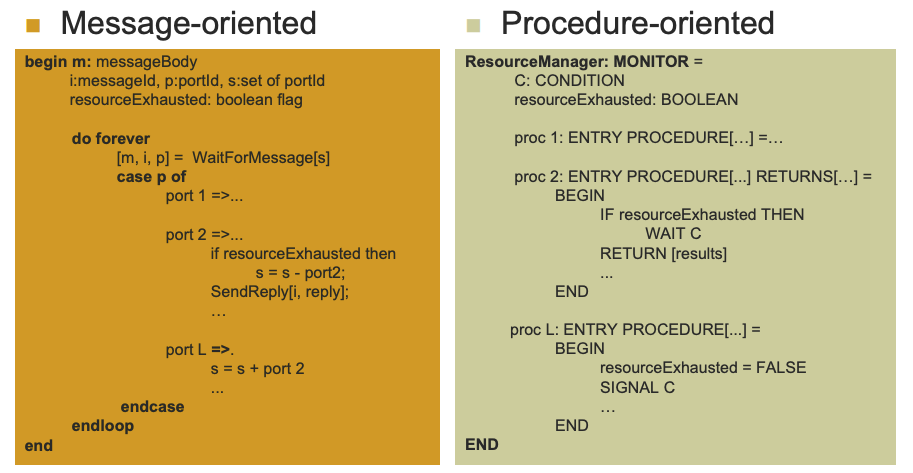
The attribute ENTRY is used to distinguish procedures which are called from outside the monitor, thus seizing the monitor lock, from those which are declared purely internal to the monitor. Any of the procedures in this module may, of course, call procedures declared in other modules for other system services before returning. Within the monitor, condition variables are used to control waiting for circumstances such as the availability of resources. These are used in this standard resource manager ,tp control the access of a process the procedure representing a particular kind of service.
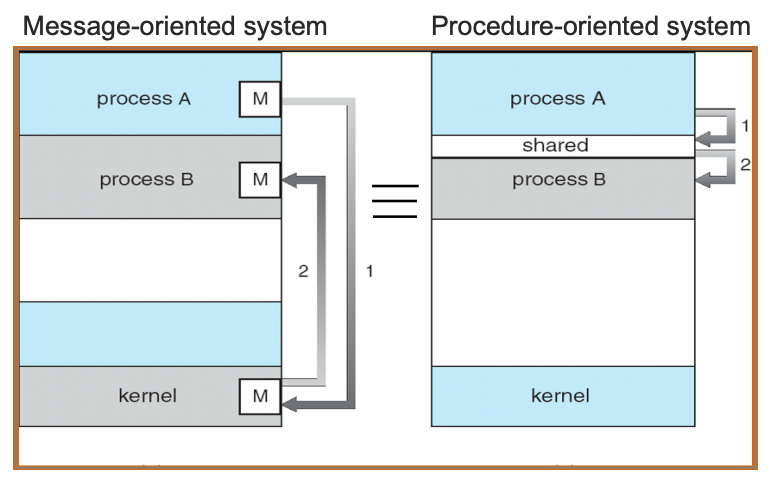
If a whole system is built in this style, then the sole means of interaction among its components is procedural. Processes move from one context to another by means of the procedure call facility across module boundaries, and they use asynchronous calls to stimulate concurrent activity. They depend upon monitor locks and condition variables to keep out of the way of each other. Thus no process can be associated with a single address space unless that space be the whole system.
|